
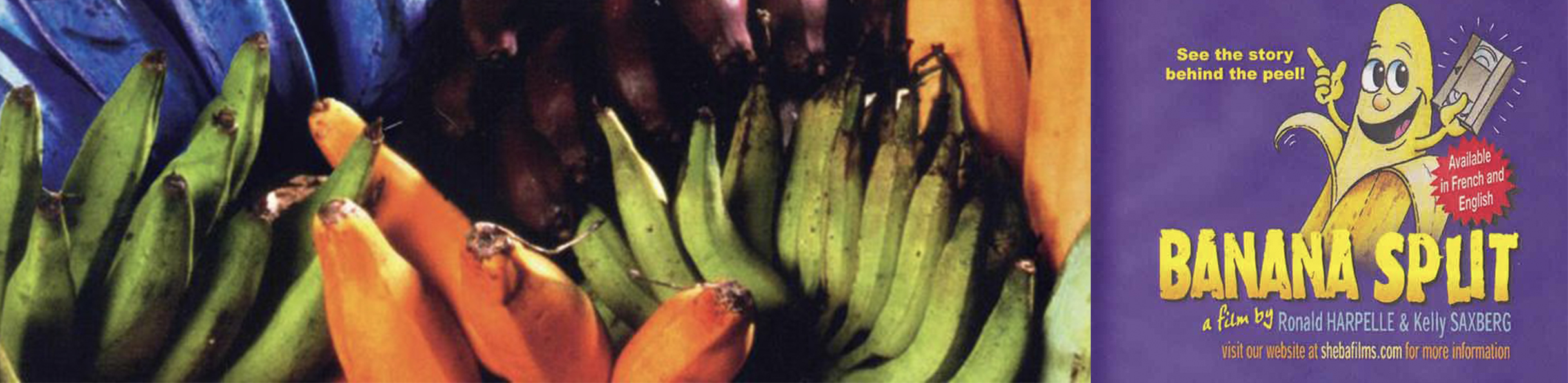
Banana Split was made with support from the Canadian International Development Agency and the International Development Research Centre. It explores some of the ongoing issues that confront consumers of the world’s most popular fruit.
The banana is the cheapest fruit you can buy in Canada at any time of the year and Canadians eat approximately 3 billion bananas a year. In Canadian supermarkets bananas account for over 10% of total sales in the produce section and 1% of total sales. All this despite the fact that the nearest plantation is 5000 kilometers away and the banana is the most perishable fruit on our store shelves. Banana Split takes the viewer on a journey that begins with the hustle and bustle of a fruit market in Thunder Bay, Ontario and ends up with an examination of the daily challenges of life in Honduras. In addition to being a popular fruit in Canada, bananas are used as a staple food in more than 100 tropical and sub-tropical countries.
In the developing world, bananas rank behind rice, wheat and corn as the most important staple food crops. Filmed in Canada, the United States, Honduras and France, Banana Split explores the North/South split between Canadian consumers and the people whose lives revolve around the “curvaceous fruit from the herbaceous plant.”
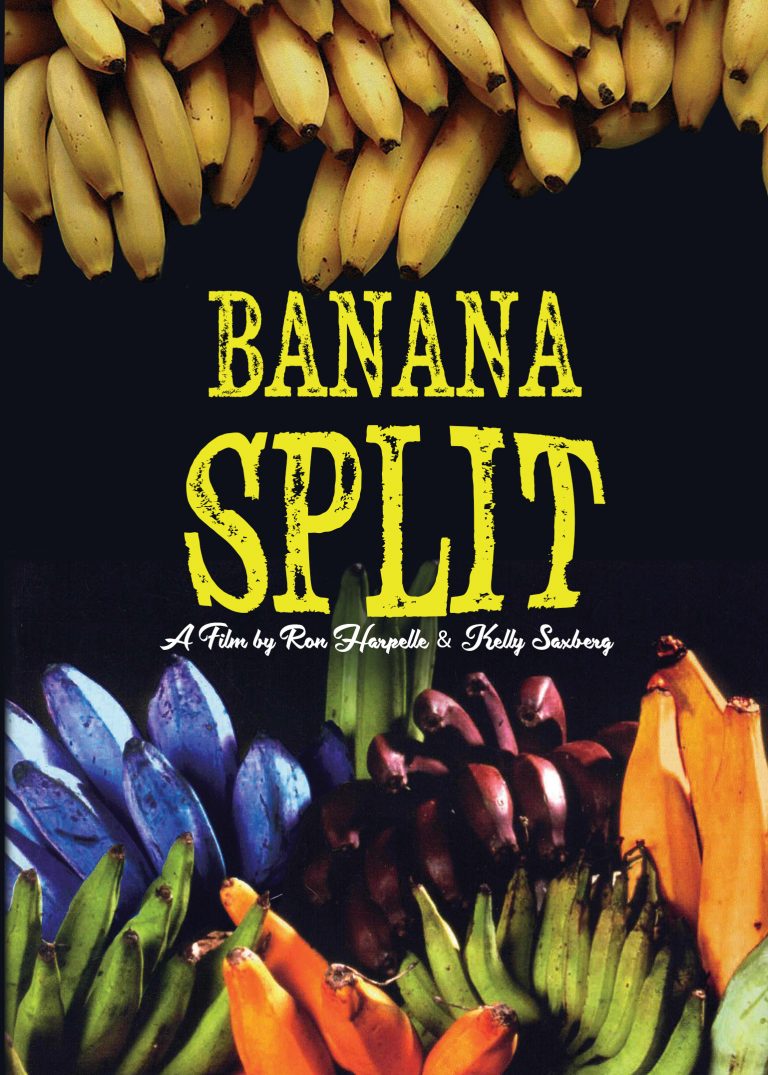
Banana Split is a winner!
Banana Split is the 2005 award winner for the “Best Feature Length Documentary” at the Latin America Environmental Media Festival in New Orleans, and it is also the 2004 winner of the Canadian International Development Agency’s Deborah Fletcher Award of Excellence in Filmmaking on International Development. In addition, Banana Split was honoured by being included in the 2003 Ökomedia – International Environmental Film Festival traveling tour of Germany and by being selected for the Traveling World Community Film Festival. Banana Split is also a core element in the Global Education Network’s teaching module on bananas. Teachers can follow the links below to find a Global Education curriculum developed for the Ontario grade 12 Canadian and World Issues course. For the English version of this module see “Bananas Unpeeled” and for the French version see Les Bananes Toutes Crues. These modules and Banana Stories/Histoires de Bananes can also be used by anyone interested in using the banana as point of discussion for globalization and related topics.
FOR EDUCATORS
Every copy of the video comes with a guide for teachers. The guide suggests ways in which the video can be used in class. Contact Shebandowan Films for more information about the Banana Split and the guide for teachers. In addition to the guide, you can access Banana Stories/Histoires de Bananes online.
Teachers are also urged to visit the Global Education Network / Le Réseau de l’éducation globale website where Banana Split is a core element in the teaching module on bananas. For the English version of this module see “Bananas Unpeeled” and for the French version see Les Bananes Toutes Crues. Banana Split est disponible en Français
Banana Split
This documentary was the product of research into the immigration and settlement of West Indians in Costa Rica between 1850 and 1950. Although the film is set in Honduras, the story of the banana industry in Central America is a repeating one. The West Indians of Costa Rica provides a detailed history of the challenges faced by a group of immigrants who were initially welcomed as labourers to work in the disease infested tropical lowlands, but then became viewed as a racial problem that threatened the White Settler identity of the country. Banana Stories is a little publication that tells the story of the banana from four perspectives. It takes a closer look at the historical, social, scientific and economic aspects of the most popular fruit in the world. This is a publication suitable for youth because it introduces the main themes of the film in a more general, but no less informative way. Edited by Ron Harpelle, this short collection of articles is downloadable in English and in French for free on this site.
Suggested Reading for Banana Split
3. Ronald N. Harpelle, The West Indians of Costa Rica: Race, Class and the Integration of An Ethnic Minority, Montréal: McGill-Queen’s University Press, (2001)
2. Harpelle, editor, Banana Stories and Histoires de Bananes
See also Bananas Unpeeled for a Global Education Curriculum based on Banana Split and developed for the Ontario Grade 12 Canadian and World Issues Course. (Version Française)