
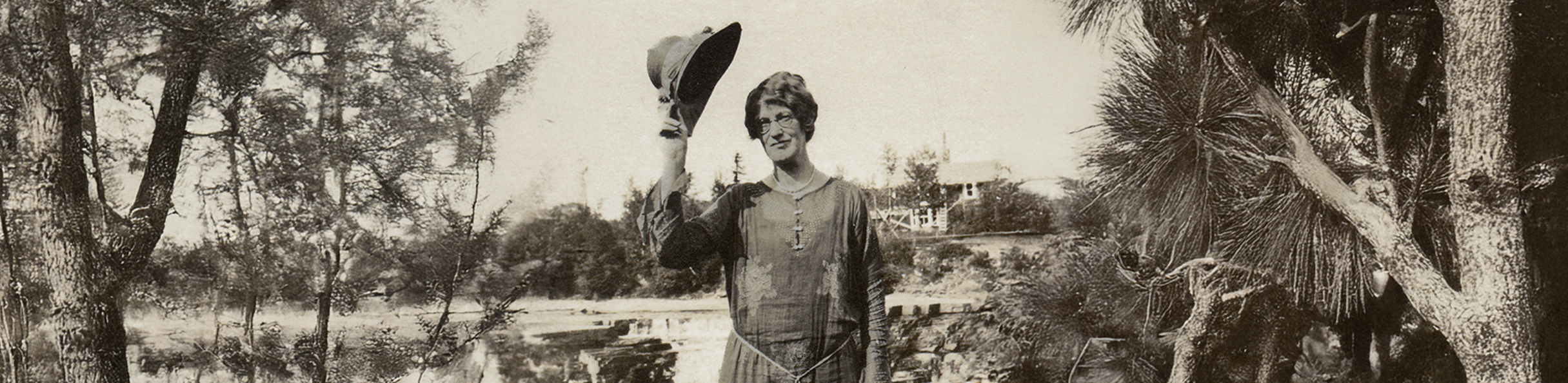
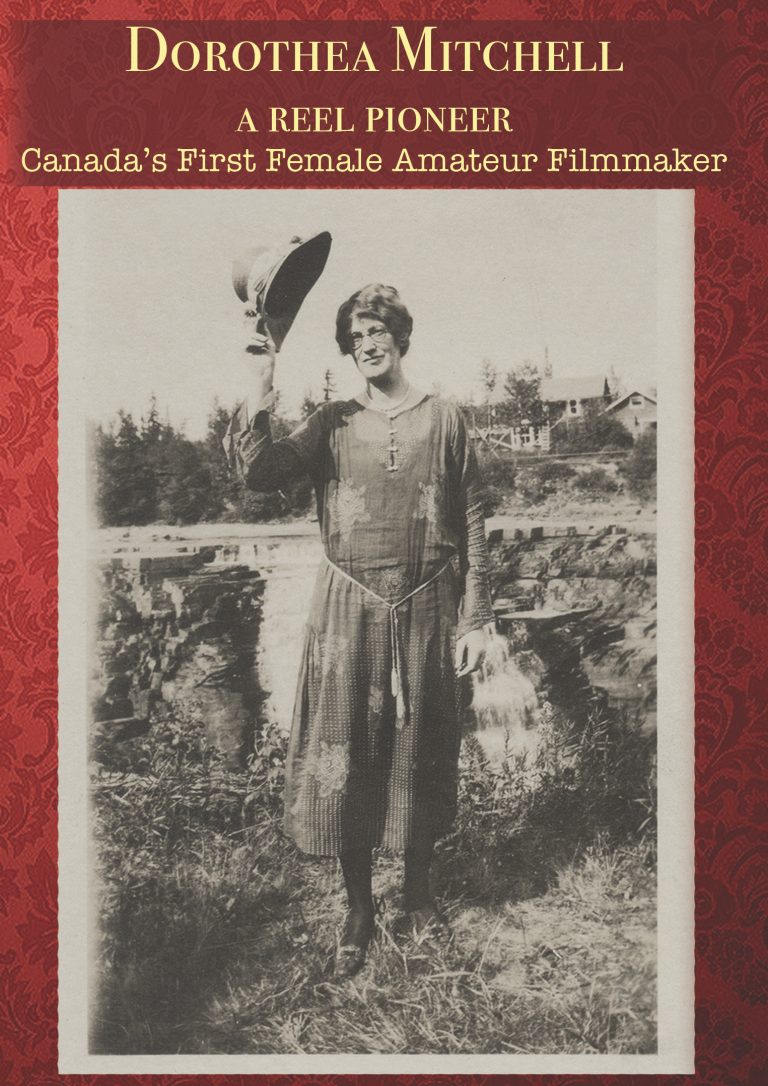
Dorothea Mitchell – A Reel Pioneer recounts in Mitchell’s own words the amazing life of a pioneer filmmaker. Seventy years later a group of local enthusiasts in Thunder Bay, reinvent the silent pictures, by finishing “The Fatal Flower”,the murder mystery Dorothea had bequeathed to the national Archives of Canada. With no script to work from and some missing scenes, the group nurtured “The Fatal Flower” back to life.
Dorothea Mitchell was born in England, raised in India, and immigrated to Canada in 1904. She was a “spinster” who chose the forests of Northwestern Ontario where she fought to become the first single woman in the province to be granted homestead rights. She staked her claim for a homestead at Silver Mountain where she built a sawmill, hired lumberjacks, and ran the local train station.
At the age of 42, Dorothea Mitchell’s artistic career began when she moved to Port Arthur, (now Thunder Bay), where she wrote, produced and starred in a series of silent films. She was a founding member of the Port Arthur Amateur Cinema Society and their 1929 A Race for Ties was the first amateur feature length film made in Canada. She and Fred Cooper, a successful baker who owned a camera, became members of the New York-based Amateur Cinema League, which was a serious effort by independent filmmakers throughout the world to compete with Hollywood. Dorothea sent away for scripts to produce, read them and decided she could do better.
To find out more about Dorothea Mitchell and the Port Arthur Amateur Cinema Society visit www.ladylumberjack.ca.
Dorothea Mitchell: A Reel Pioneer and The Fatal Flower
The Lady Lumberjack is a complete collection of Dorothea Mitchell’s writings. It contains her book, Lady Lumberjack, and several short articles about her time in Northwestern Ontario during the 1910s and 20s. Dorothea Mitchell was a Canadian Pioneer of the first order. She did things that pioneering women have always done, but her pioneer experience was made more difficult by the fact that she was a single woman. Unlike other unsung heroines of the early twentieth century, we know of Dorothea’s accomplishments because she wrote about them.
“Historians often have identified Susanna Moodie or Catherine Parr Traill as advocates for women’s rights, but Beaulieu and Harpelle argue emphatically that Mitchell’s contributions are equally important. Taken as a whole, Lady Lumberjack is as entertaining as it is insightful. Dorothea Mitchell was a gifted writer, her prose at times resembling that of Pulitzer Prize winner Annie Proulx. In all likelihood readers will find themselves missing Mitchell long after they have finished reading the book. This unassuming woman captivates one with her humorous shenanigans while, at the same time, astounding one with her no-nonsense approach to everyday matters typically considered the liberty of men. Lady Lumberjack is a serious contribution to women’s history, with huge potential to inform novice and seasoned academics alike. Mitchell’s writings are ripe with examples of emerging ethnic and racial tensions, national pride and shifting gender roles. Such broader themes need only be teased from the pages. Beaulieu and Harpelle have ably shown the numbers ways in which Dorothea Mitchell stood as a symbol for all that women could achieve.”
Cheryl Desroches, Queen’s University
Suggested Reading for Dorothea Mitchell and Fatal Flower
Ronald Harpelle and Michel Beaulieu editors, The Lady Lumberjack: An Annotated Collection of Dorothea Mitchell’s Writings, Lakehead University Northern and Regional Studies Series, (2005)
See also http://www.ladylumberjack.ca, a website that provides a brief introduction to Dorothea Mitchell along with educational resources and a long-forgotten filmstrip that was produced by the NFB in the 1970s. This website is suitable for younger audiences and can be used to teach about the making of silent films.