
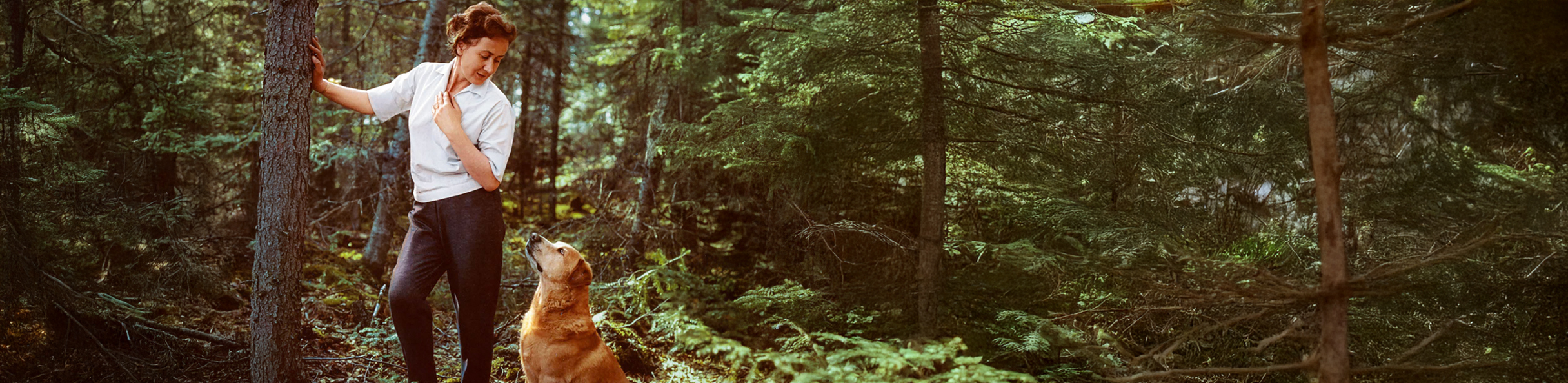
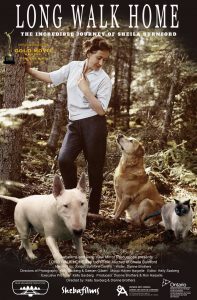
Long Walk Home: The Incredible Journey of Sheila Burnford is a documentary about a writer adventurer who grew up in Scotland, survived the Blitz in London, emigrated to Thunder Bay, and spent the last 20 years of her life either at her cabin on Loon Lake; on a remote reserve or an Arctic community or her writer’s garret in Sussex. The 1963 Disney movie based on her classic novel “The Incredible Journey” made her famous but her real accomplishments as a writer were yet to come.
Sheila Burnford is best known for writing The Incredible Journey, which was published in 1961. The Walt Disney film adaptation was released in 1963, making the book an even bigger success.
However, there was a great deal more to her life than this one book.
She was born, Sheila Philip Cochrane Every in Scotland in 1916. She was educated in boarding schools throughout England and Europe (including a year in Germany as Hitler took power).
She was one of the first women in Scotland to receive her Aviation Certificate. During the Second World War she worked as an ambulance attendant and driver.
She married Dr. David Burnford in 1941. They had three daughters; Peronelle, Jonquil and Juliet.
In 1948, the Burnford family immigrated to Canada, settling in Port Arthur, Ontario (now Thunder Bay).
Sheila loved the great outdoors, particularly walking and hunting. She became friends with local artist Susan Ross. The two shared an interest in the lives of indigenous people and they inspired each other in creative endeavours. Both Sheila and Susan were members of the Port Arthur Puppetry Club. It was during her time with the Club that Sheila began writing – scripts at first and then articles describing life in Northwestern Ontario for English magazines and newspapers such as Punch and the Glasgow Herald.
Sheila was a great animal lover, although she always said she had a practical view of them. After the death of her Bullterrier, Bill (who had kept her company during the Blitz in the Second World War) she decided to write a book, in part to memorialize him.
That book became The Incredible Journey.
The animals in the book were based on the personalities of her own animals. In addition to Bill, she had a Siamese cat (Simon) and a Golden Labrador (Raimie). She researched incidents similar to the one in the book and used the area around her home and cottage (Loon Lake) to describe the terrain.
The book was an international best seller and was eventually translated into more than 17 languages. It would win a number of awards including the Canadian Library Association Book of the Year for Children Award (1963) and the Aurianne Award (1963).
In 1963 the Walt Disney adaptation of the film was released. The premiere of the film was held in Port Arthur with over 10,000 people lining the streets for the parade preceding the showing. Actors from the film and the film’s director, Fletcher Markle. Attended the premiere. Although the book was based in Northwestern Ontario, it was actually filmed in the Toronto area.
In 1964, Sheila published her second book, The Fields of Noon, a collection of essays on life in Northwestern Ontario. It included a number of essays that had previously been published in English periodicals.
In the late 1960s, Sheila and Susan Ross spent a great deal of time visiting native reserves in Northwestern Ontario. Both women has long held interest in native life and found the opportunity to actually learn about native life to be irresistible. While there, Susan Ross drew sketches of the people and Sheila observed. As a result of these visits, Sheila published Without Reserve (1969), using some of Susan Ross’ drawings as illustrations.
Sheila and Susan next travelled up to Pond Inlet and experienced the life of the Inuit, including travelling by dog sled to see the narwhal. From this experience came One Woman’s Arctic (1972). This book also included illustrations by Susan Ross.
The Incredible Journey was acclaimed as a children’s book, even though Sheila herself did not think of it as a children’s book. In 1973, she published an actual children’s book Mr. Noah and the Second Flood. The story focused on the impact of consumerism and waste on the planet.
Sheila’s last book, Bel Ria: Dog of War (1978) was the story of a little dog caught up in the horrors of the Second World War. Inwriting the book, she drew upon her own experiences in the Blitz and used research to maintain authenticity.
In 1984 Sheila Burnford died of lung cancer. She had moved back to England to live with her second husband Dr. J.D. Loughborough.
Long Walk Home: The Incredible Journey of Sheila Burnford
The best Canadian literature is shaped by our history and geography. Sheila Burnford is best known for writing The Incredible Journey, a book that was translated into several languages and made into two Disney films. What people do not know is that she also wrote five other books, both fiction and non-fiction, and numerous articles that were published at home and abroad. Burnford wrote about many subjects, but most of her writing either dealt with or was heavily influenced by her experiences in Northern Ontario and the Arctic.
Shiela Burnford did not write in isolation. Following her family’s move to Thunder Bay in 1948 she developed a lifelong friendship with Susan Ross, an Order of Canada award winning artist who was the niece of the “father of documentary” Robert Flaherty, famous for Nanook of the North. Together, these women befriended artist Norval Morriseau, who opened doors to northern Ontario First Nation communities. Burnford and Ross began their own incredible journey, focusing their attention on First Nations and visiting many remote communities for extended stays. Neither woman was trained as an ethnographer, but their work–Burnford’s books and articles, illustrated by Ross’s sketches–were some of the most insightful studies of isolated First Nations communities in the 1960s and early 1970s.
In 1964 Burnford published Fields of Noon, a collection of pensive essays about everything from her experiences with archaeology to hiking in the Pyrenees. This was followed by Without Reserve (1969), a book aimed at enlightening a non-Native audience about First Nations. After spending two summers at Pond Inlet on Baffin Island with Susan Ross, she published One Woman’s Arctic (1972), an account of her impressions and experiences. Without Reserve and One Woman’s Arctic became academic staples, and are used by researchers to this day. In 1973, she published a children’s book entitled Mr. Noah and the Second Ark (1973), a cautionary tale about pollution and the environment. She ended her writing career with Bel Ria: Dog of War (1978), a book that drew upon her personal experiences in Britain during WWII.
Suggested Reading for Long Walk Home
Books by Sheila Burnford
Bel Ria: Dog of War, New York: New York Review Children’s Collection, (1978)
Mr. Noah and the Second Flood, Praeger, (1973)
One Woman’s Arctic, Hodder & Stoughton Ltd, (1972)
Without Reserve: Among the Northern Forest Indians, Little, Brown and Company; (1969)
The Fields of Noon, Little Brown, (1964)
The Incredible Journey, Hodder & Stoughton Ltd, (1961)